In filmmaking, split-screen is an editing technique that is used to get two different scenes on screen simultaneously, the most simplistic use of this technique is usually to have an actor appear in a scene twice on the left and right of the screen.
Used widely in films for a variety of reasons, Scott Pilgrim vs The World (2010) uses this editing technique due to its comic book style.
While 500 Days of Summer (2009) uses it to contrast the sad reality and the dream/expectation of meeting an ex after a long time.
Split-screen has been used countless times in film for a variety of purposes from granting another perspective on a scene to instilling simultaneous emotions and goals of characters. Premium Beat breaks down notable examples from Cinema that I have taken certain notable ideas of split-screen from.
My Own Example with Horror Editing Conventions
Due to the flexibility of the editing technique, I thought I would apply it to horror short by using horror film editing conventions in combination with Split Screen and see how effective they would be combined.
Cross-Cutting
The horror genre uses cross-cutting to add suspense and terror within an audience, the most common reference to this being Jaws (1975) where the scene cuts back and forth between the shark and its prey. This is to create a sense of dread in the audience as we see a character usually unaware of the threat believing themselves to be in relative safety contrasted with the nearing danger of a threat they cannot see, but the audience can. This in combination with the split-screen effect worked well in the short as I applied the same concept but with two different images as one shows the man in the safety of his home and the other a killer stalking them through the window. The same effect but applied with two different pieces of footage rather than two cuts back and forth.
I also used long takes in this scene to enhance dread by taking the convention from horror films like Alfred Hitchcock's Psycho (1960) which uses the length of the shot to set up a scare for the audience. In that film, it is the woman in the shower and the shadow of the killer growing closer. For my short film, the long takes of the stalker outside of the man's home as he grows closer and closer to getting inside was my take on this editing technique as I hid cuts within my characters movement to make it seem like a single long take. By having the same scene play out in this single shot style from two different perspectives it also created a temporal loop where we see the man get killed twice which I thought created a quite unique and original ending to the sequence.
Used in horror to disorientate the audience this can be to showcase characters confused/dazed state of mind during a horror film as the camera movement speeds up to indicate their fear/paranoia or it is the implementation of a jumpscare as the sudden transition scares the audience and the characters as it's timed with a jarring sound effect/movement the audience wasn't expecting. This is usually in combination with long takes and crosscutting in order to create a setup for the cut leading to the scare, as it creates more and more tension the longer the wait to the release of the scare. One of the best examples of a jump cut in a horror film is in the film Sinister (2012) when it jumps cuts to the man's reaction to a horrific video. I demonstrated the use of quick/jump cuts in my project as in the climax the shots become rapid and cut between one another at a quicker pace to represent the struggle of the man as he gets choked to death.
The Art of Editing Horror | Dissecting Fear by GammaRay
Conclusion
While I think I successfully demonstrated the editing techniques of the horror genre as well as the split-screen technique I think I could have better implemented audio editing of a horror film by adding dramatic instrumentals to apply tension. While I did use an atmospheric metallic instrumental soundtrack which successfully set up my clip as being horror genre inspired due to it being very unsettling according to my peers. I feel I could have better improved the piece by adding in some common conventions of sound design/editing pointed out by GammaRay in their video. Such as animal noises which would have been very impactful during the struggle between the man and the killer and droning sound effects to emphasise the silence.
The Sounds of Horror | Dissecting Fear by GammaRay
How Do Horror Scores Condition Us To Be Scared?
Reference List:
Maher M, February 19, 2016, "The Art of Split Screen" (Online) Available at:
Shutter Speed is the length of time when the film or digital sensor inside the camera is exposed to light, also when a camera's shutter is open when taking a photograph, in the case of the video the shutter is a plate located between the lens and the film stock/CCD (Charged Coupled Device) chip. Is measured in fractions of a second (1/50, etc.) and is altered to change exposure rate and is used artistically to show the altered state of a character's mind. No Film School
Shutter Speed can be altered for many reasons, to speed up or slow down a scene both examples can be seen in this clip from Spider-Man Movie (2002) where Peter fights Flash, as the scene uses shutter speed to increase the speed of Flash to make him feel more dangerous and slows down the scene to show Peters newfound reaction speeds gained from his new powers.
Here is my personal footage example of Shutter Speed examples that clearly outlines and showcases what difference this makes to the video final product. By recreating the same action at different Shutter Speeds.
Making Peters speed seem un-natural highlighting how he has now gained super agility after getting super powers.
Reference List:
NoFilmSchool.com, Renée V May 16, 2018, "5 Ways to Creatively Use Shutter Speed in Your Film" (Online) Available at:
Pull focus or Rack focus is used in in films and other media products to pull a model (object or otherwise) into the focus of a camera lens. This is to demonstrate the realisation of a characters inner thought/realisation.
In both my personal examples this is demonstrated with certain parts of the frame being put into the focus of the camera, the hand on piano becomes the focus of the scene as it comes into focus further inforced by the matching diegetic sound of the keyboard and the bottle rolling into to focus to empathise its importance to the shot. The final breakdown of the case in the last act of the film Knives Out (2019) when the letterbox is pulled into focus to emphasise the key evidence of the blackmail letter is a perfect example of this in modern film and showcases my accuracy in duplicating the effect. I have also included a breakdown of this effect/technique by Studiobinder where they use movies like Casino Royale (2006).
In conclusion, my clips showcase clear examples of Pull Focus and by comparing them with Knives out clip demonstrate how they should be used in a sequence/film. However, I wish I could have added narrative elements to these clips to provide a more visual and engaging example for viewers.
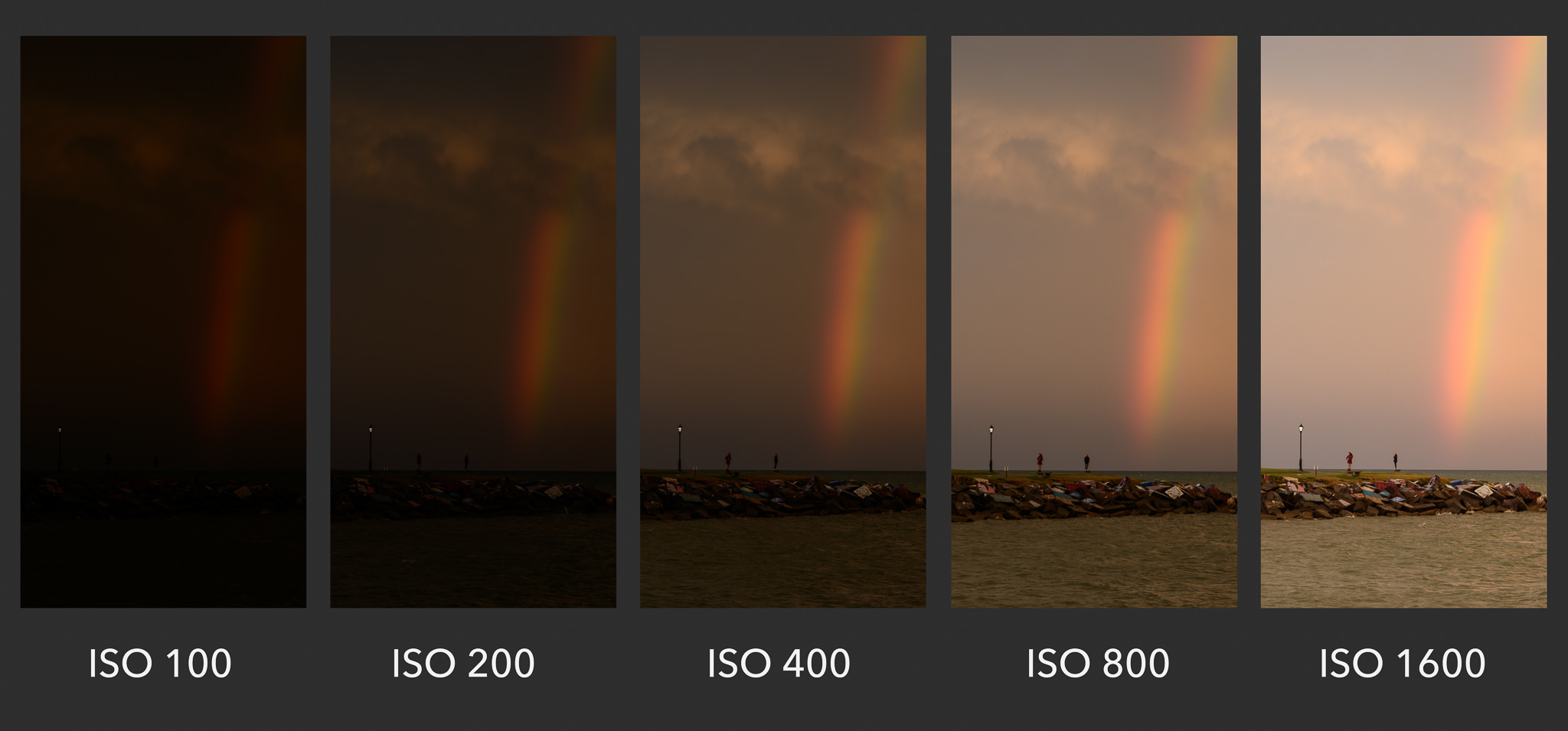
International Organisation of Standardisation/ISO is what measures your camera’s sensitivity to light. To clarify the lower the ISO number, the less sensitive the sensor is to light. High ISO numbers have high light sensitivity. Studiobinder. My footage clearly outlines the intended model by using varied ISO numbers of the in the same environment and showcases the clear lighting difference and how these numbers of ISO could be used in certain situation to get the perfect lighting of your frame without the use of lighting equipment. The difference in filming in both day and night with the same ISO, the lack of detail surrounding the light in the night scene and the clear image of the dumpster and street in another by adjusting my other effects like aperture and shutter speed to better frame my examples of ISO.
Films use ISO in combination with Aperture and shutter speed to get the best possible exposure for a scene, a greater showcase and breakdown of this exposure triangle is by Studiobinder, as they breakdown examples from various films like 1917 (2019).
Overall I think my footage demonstrates the differences in ISO levels and however I wish in my videos I had broken down how to use them, like a video tutorial. An example being for daylight shoots use ISO 100 or 200 and for Indoors generally ISO 400 and so on.
From the Editing Clips section, I learned how to zoom in and out of certain clips to have more detailed editing by being able to extract or insert sequences together frame by frame.
Exporting Your Work section taught me how to properly construct my media files to be exported into complete sections and keep their original quality.
I learnt how to enhance and change the colour of the original footage of a clip in the Adjusting Colour of Clips section which will allow me in the future to make my footage appear to be at a different time in the day or allow me to colour code my frames for extra meaning.
Organising Footage Evidence
During my projects, I organised my footage for the ease of the editing process. As it allowed me to locate what I needed for each stage of editing, despite the vast number of video files.
Folders
I separated my footage into separate files for different elements of the project, for example during my Music Video Project I filmed on two different days so I created two different files one for the first shooting day "Lust of a Vampyre SD1" SD being short for Shooting Day. This allowed me to better find the footage from both days easier.
Re-Naming Files
I also renamed specific pieces of footage I wanted to use in my production, this was to better fit these shots into the edit as I filmed them for certain segments in the sequence/project.
Raw Project File's
Had my project files saved on adobe cloud in their still editable state allowed me to re-edit certain details after seeing the exported version to fix problems I didn't see while editing and allowed me to go back and take screenshots for editing evidence.
Final Project with All Footage Files
After the project was complete I organised them into folders with the footage I used for each of them. This was so I could go back to look for certain pieces of footage that I wanted for other projects but also keep my computer organised for future projects by operating footage from complete sets of work (which was particularly useful when I was doing multiple projects at the same time).
Bins
Organized my Bins for the ease of the editing process, allowed me to pick shots for certain beats of my sequence structure that I planned out with my storyboard for example I separated the exterior shots I wanted for the establishing shots at the beginning of my music video so I could find them more easily while editing. This also saved me time as it meant I didn't need to rename each but footage to know what it was.
The 180-degree rule is a filmmaking guideline for space between two characters on screen (setting an invisible axis/eye line, between two characters or between a character and an object). By following this rule it keeps the space of the scene easy to follow by not having the audience drastically alter there sightline. (Alex Ferrari 2019) IndieFilmHustle.Com, (SC Lannom 2019) Studiobinder 180 Degree Rule
The 30-degree rule is a rule used in filmmaking with the purpose of creating continuity between different shots within a larger sequence of shots. Similar to the 180-degree rule this is used to keep the image from feeling jarring to an audience and allow them to concentrate on the image in the frame. LightFilmSchool
A shot reverse shot refers to when a camera setup on a subject, and then uses a subsequent set up to show the reverse view. Usually used to showcase a conversation between two characters and is in combination with the 180 and 30-degree rule. (SC Lannom 2019) Studiobinder
The establishing shot is used to showcase the setting of a film or media text. Most commonly used in combination with a Birds Eye View perspective and Long/Extreme Long Shots with Tracking camera movements. (Jason Hellerman 2019) Nofilmschool
Cut ins are used to indicate the emotions of the character in the scene by cutting into the expressions of the actors. This is most commonly used with Closeup and the Zoom In-camera methods as talked about within the website Studiobinder
Temporal Overlap is when the same action of a scene repeated multiple times either from the shot being repeated or the same action from a different camera angle/position. (Cato Wittusen 2014) Varieties of temporal overlapping and depth
Match on Action refers to an editing technique where the editor cuts from one shot to another view that matches the first shot's action. Such as someone entering or exiting a building, most commonly used when transitioning from one scene to another. VideoCide:
Kuleshov Effect is an emotional response created by an editing technique of having the characters facial expression contrasted with another shot that changes how the audience perceives the characters expression. As Alfred Hitchcock expertly said with his example of a man's reaction to a woman in a bikini and how it changes when the images are changed to a baby. (Mike Springer 2012) OpenCulture
Eisenstein's Methods of Montage (five methods of montage):
Metric Montage, refers to cutting in exact measurement rather than the content of the shot. To clarify according to (Chris Heckmann 2020) Studiobinder Metric Montage is inspired by the pacing of a music score/the meter of sound in a film. Used to create a visual pace within a scene by cutting to the next shot after a finite number of frames despite action in the scene. October: Ten Days That Shook the World
Rhythmic Montage, if Metric Montage is used to establish a visual pace, then the Rhythmic Montage is used to keep to the pace with is the use of sound and visuals and the continuity this creates based on matching action. Rocky Training Montage
Tonal Montageuses the emotional meaning with the use of two or more shots that support one another to build a theme that gains a reaction from the audience, which can be used with a combination with other montage methods like Rythmic.Nerdwriter's Analyse on Parasites Perfect Tonal Montage
Intellectual Montage, uses images to create meaning or metaphors for the audience to understand messages of the sequence usually used in combination with the Kuleshov Effect. 2001: Space Odyssey Dawn of Man
Over Tonal Montage, the combination of all 4 other methods of montage. This is to help induce an effect on the audience and help them feel emotionally connected. The Untouchables Stairway Shootout is a perfect example of this by using all methods of montage:
Establishes pace (Metric), Keeps to the pace (Rhythmic), Evokes an emotional response (Tonal) and Exaggerates the emotional response through supporting/contrasting images (Intellectual).
Defining a new wave, an artistic movement in the film that influenced future filmmakers and captures the culture and zeitgeist of the time period.
I will be concentrating on the niche horror movement in Italian cinema known as Giallo, the evolution took place as the nation’s political climate became more unsettled and film-makers strove to outdo one another’s kill scenes and gore effects, often at the expense of character and plot.
Giallo = Yellow, from the yellow pulp crime novels in the '20s and '30s, this was later the word to describe the genre as these novels were adapted and the storylines and tropes carried over to the genre. Giallo was concentrated in the "1968's and 1978's" however my 3 films I will be analysing will be in the late 70s but I will also talk about its origins in the 60s and how social issues/context of the time effected and were explored in these films. Muchadoaboutfilm.com
The Giallo Genre (plural, Gialli) are Italian-produced murder-mystery thrillers which feature scenes of excessive violence often originally choreographed which blur the lines between art and exploitation cinema. Films of the Giallo genre usually include strong elements of horror and eroticism, the latter often in the form of voyeurism.
Wonderfulcinema.com
According to Hélène Cattet, Bruno Forzani the directors of Giallo inspired films like Let the Corpses Tan (2017) define a Giallo films plot in 3 different categories with an interview withCineFix.
"1. It's a who done it with a black-gloved killer 2. Its a conspiracy involving manipulating parties 3. Erotic violence"
Social Issues/Context Explored in Giallo
Economic Miracle of the 1960s
As Italy transitioned into the 1960's they had a huge economic boost transforming there rural poor country into an urban richer cultural hub within Europe.
Due to the fall of the previous fascist restrictions allowing further trade unions in the 1940s which increased the production of consumer goods from typewriters to Vespers within Italy, which was then further amplified by the Korean War in the 1950s creating this significant economic change in just under two decades an “Economic Miracle” as it was dubbed during the time. Giallo used this social change through there protagonists who were often outsiders in Italy and showcases how the citizens of Italy felt like these outsiders/tourists as the fast and radical change of there nation confused and intrigued them showcased through the main character's common troupe in a Giallo film being a main character's obsession/need to solve the murders one of the most notable examples being in The Bird with the Crystal Plumage (1970) as the lead conducts an investigation to solve a set of murders after witnessing an attack in an art gallery (example of there found significance as a cultural hub). Britannica.com
Italian Economic Miracle, the 1960s - Film 16062
Changes Caused Sexual Revolution/Fears of Female Independence
The new waves showcase of violence towards women usually through phallic imagery such as knife penetrating a female victim can be seen as a fear of the new sexual freedom women which had started through the creation of the Contraception Pill in 1961 which kicked off the sexual revolution of the '60s, This could be seen as a graphic metaphor for the fears of sex outside of marriage as the violence mixes with voyeurism and the male gaze these techniques could be a nightmare male perspective as they seek to control and contain woman's sexuality and how Italy's former conservative religious ideals had begun to change with the modern era.
The Giallo new wave also showcases fears of female independence through the use of female characters in their films whether it's outlining men's loss of masculinity in Deep Red (1975) or through the fear of organised female groups like the coven of female witches in Suspiria (1977). Inspired by the 1970s forming of the law on divorce and the 1978 law on abortion in the Italian government, Life in Italy. Showing the further drift away from female dependency on men, as women had begun to form there own political groups of female activists against male-orientated governments and systems and these characters in Giallo films representing this fear by men that they were being made redundant by women.
Clip from The Sexual Revolution 1961 by Moments of History
Mario Brava
Regarded as the earliest creator with his work is one of the first examples of Giallo films as a Director, Screenwriter and effects artist for films, however, his work was not what popularised the genre and style. Most known for his work like, The Girl Who Knew Too Much (1963) and Blood and Black Lace (1964).
Born on 31 July 1914 he originated as a painter he adapted into a cinematographer and eventually becoming a director due to the dubbing of Italian films into the native language of films they were released in (which continued throughout the Giallo movement) he and the rest of early Italian Cinema focused on visual elements as a painter Mario founded the New Waves bright colours and their non-dialogue orientating around composed and beautiful shots rather than a linear narrative. After his various saving of abandoned projects in the 1950s, he created Mask of Satan/Black Sunday (1960) his first film which was inspired by the British hammer horrors Bava tested the censorship rules of horror and established the international interest of horror. This testing of boundaries were the origins of his creation of Giallo which he established through his inspirations of Alfred Hitchcock films leading to the groundwork of all Giallo Blood and Black Lace (1964). Despite his lack of success in the mainstream Bava's impact on Italian horror/the horror genre as a whole cannot be understated.
Mario Bava - The Genremaker by History of Horror
The Girl Who Knew Too Much (1963)
Blood and Black Lace (1964)
Dario Argento
Regarded as formerly the most prolific Giallo film director who brought the genre and style to its height in between the '70s and '60s. A true Auteur of the Horror genre his work influenced both Italian, as well as the rise in horror in American cinema in the 80, 's such as his Demos movies. However, his most famous work released at the height of the Giallo new wave (1968 and 1978) most known for his films: The Bird with the Crystal Plumage (1970), Suspiria (1977) and Deep Red (1975). FilmSchoolRejects
Born on 7 September 1940, Dario Argento started out his career as a film critic his father worked in films and his mother was a photographer. He was immersed in cinema from an early age as it honed his photo-like imagery in his films. Having a vivid imagination he crafted dream and nightmare worlds which he constructed with colour and his love of writers like Edgar Alan Poe, whos crazed paranoia greatly impacted his work. So when he quit being a film critic after crafting his image loving taste in cinema leading to his focus on cinematography. Getting his start in westerns like once Upon a Time in the West (1968) which he co-wrote. He then directed his first film The Bird with the Crystal Plumage (1970) which was twisted and extended the troupes of Giallo into the '70s and the rest is history as his nightmare and explorations of social issues from fears of women's independence (outlined in films like Suspiria) through his psychedelic colours and imagery as he elevated the Giallo New Wave at the height of its popularity.
Documentary: Dario Argento - An Eye for Horror (2000)
The Bird with the Crystal Plumage (1970)
Suspiria (1977)
Deep Red (1975)
The 3 New Wave Films I am Analysing
My three films from this wave that I will be analysing are all going to be from the Dario Argento height in the genre, starting with The Bird with the Crystal Pilgrimage (1970), Deep Red (1975) and Suspiria (1977) and how he was inspired by the work of Mario Brava. I will discuss how these films inspired the early origins of the slasher sub-genre in America during the 1980s, overall how these films changed horror and cinema forever.
The Bird with the Crystal Pilgrimage (1970)
Synopsis
Dario Argento's directorial debut "An American expatriate in Rome witnesses an attempted murder. He learns later that it's connected to an ongoing murder spree in the city, and decides to do his own investigation, despite being personally targeted by the killer" IMDB
Written and Directed by Dario Argento starring Tony Musante, Suzy Kendall, Enrico Maria Salerno this film was his directorial debut Dario Argento this movie inspired by the Fredric Browns novel "The Screaming Mimi" which had its own adaptation in 1958 this is wildly considered by critics like Mark Kermode as "the Benchmark for a Giallo film" BFI. This movie mixes both sexuality and psychology snd is the reason why Giallo movies have continued with the emphasise of sex and violence in future instalments and comments on fears of independent women.
With Cinematography by Vittorio Storaro who would later work on films like Apocalypse Now and the last emperor and is a perfect example of Dario's love of haunting beautiful imagery from being trapped in a glass box to an art piece almost killing the protagonist in the last confrontation.
The 1st of his self-named animal trilogy which would include Giallo classics like The Cat O' Nine Tails (1971) and Four Flies on Grey Velvet (1971), this was the film that started his path into changing horror forever.
Deep Red (1975)
Synopsis
"A jazz pianist and a wisecracking journalist are pulled into a complex web of mystery after the former witnesses the brutal murder of a psychic." IMDB
Deep red or Profondo Rosso in its native Italian using the mystery elements of the Giallo an underrated classic of Dario Argento who directed and co-wrote with Bernardino Zapponi and starred David Hemmings, Daria Nicolodi, Gabriele Lavia in his finest Giallo film in my opinion. This is due to it perfection in the structure of a Giallo film if you are looking for the Giallo film to define Giallo Deep Red certainly does that as it uses the aspect of mystery which Giallo was founded on with its use of stunning visuals to create a film that would perfectly capture the methods of this Wave of Cinema. And would inspire people like Guillermo del Toro's career as a filmmaker and even inspire the modern horror of Saw (2004) with its mascot Billy being inspired by the puppet in this film.
This film also expressed fears of female independence at the time with the female reporter in the film out doing the protagonist in many aspects considered to be more masculine at the time and showcases examples of female characters with just as much death and complex motives as males in films, which for the time period and even today is unfortunately not popular in the way we write stories.
Suspiria (1977)
Synopsis
"An American newcomer to a prestigious German ballet academy comes to the realization that the school is a front for something sinister amid a series of grisly murders." IMDB
Made after the success of Deep Red Dario Argento directed and wrote Suspiria with Daria Nicolodi and stared Jessica Harper, Stefania Casini, Flavio Bucci. Argento's peak of narrative and visual experimental as he mixes bright colour and music to create a maddening horrific multi coloured nightmare its use of synth music which can be cited as a clear piece of inspiration for the horror soundtracks of legends like John Carpenter who uses the same synth techniques to create a similar atmosphere in the majority of his filmography.
This film is definitely Dario Argentos best technical accomplishments form a film form the set design of the school to the lighting and camera positioning and techniques this film is a technical marvel that holds up even today as he utilizes large environments to make dream world on-screen feel real. This is also due to collaboration with the soundtrack done by Goblin which creates such an original and emotional film that hypnotizes you with each film making aspect it demonstrates.
Reference List:
WolfCrow.com, "What is Low-Key Lighting?, What is low-key lighting, and how do you apply it in cinematography?" (Online) Available at:
CineFix, "Everything you Need to Start Watching Giallo" (Online) Sep 21, 2018, Available at: