What is a Questionnaire?
A research instrument which gives a set of questions for Respondents (people who have participated in a study, in this case, it would be someone who has voluntarily taken a questionnaire) to answer these questions and has there answers added into the data from all the other participants who also partook. The reasons for collecting this data depends on the data collects who may have been hired to collect the data. Most often questionnaires are used due to their low cost compared to other research methods to predict human behaviour (preferences, opinions, etc.) in a quick and easy manner.
As Ian Brace states in his book "Questionaire Design: How to plan, structure and write survey material for effective market research (Second Edition)" he explains that "Questionnaires are written in different ways, to be used in many different situations and with many different data-gathering media".
Basically, questionnaires are a fluid research method that can be adjusted for whatever the client desires. Whether they are collecting data for a company to create a perfect product for a certain demographic or a group of psychologists trying to prove their psyche theories (Freudian theory, etc.).
What to consider when creating a Questionnaire?
Validity
The validity of a questionnaire and any other research method is how accurate the data collected from it is measured. This is important to consider as if you cannot accurately measure the data you have collected it is useless as it cannot be applied in any way. For example, if the government did a survey for what people in the UK will be negatively affected by Brexit and had no way of accurately measuring/analysing that data. They would have no way of applying support to those people who needed it.
Reliability
The reliability of a questionnaire and any other research method is the state in which it yields/provides stable, consistent data. Using the same unit of measurement to get consistent results, for example, a questionnaire, you would need each questionnaire to have the same questions because otherwise, the data would be useless.
Triangulation
Triangulation when using research methods is the use of multiple sources of data/data collection to give more validity to your research collected in a study. This is also used when allowing multiple evaluators to break down and analyze the response of respondents in the study. Important when creating a questionnaire as having more data to back up what you have collected from your questionnaire gives more evidence that your data is reliable/accurate.
Pilot Study
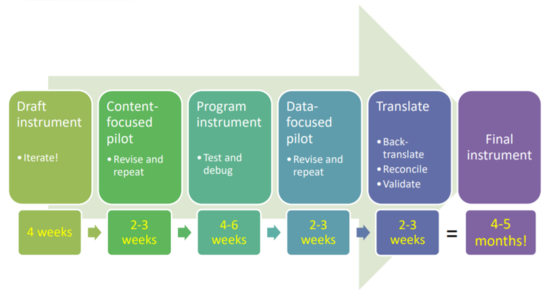
Referring to a significant stage of a researching method. The reason for using a pilot study is to showcase if it can be used on a grander scale. This stops you from overspending when collecting data and finding ways of simplifying your research method, in this case, a questionnaire to better be analysed in the future.
Sample
Sample refers to a group (usually of people but can be objects, animals, etc.) from a larger population to measure. This should represent the population of what you intended to get data from in order for you to simplify and apply findings to the larger population in post. Allowing you to gather data for a city with only a fraction of the population and cost. Sample needs to be considered to give your data validity as if the sample is not accurate to the respondents you want to study your data will become useless.
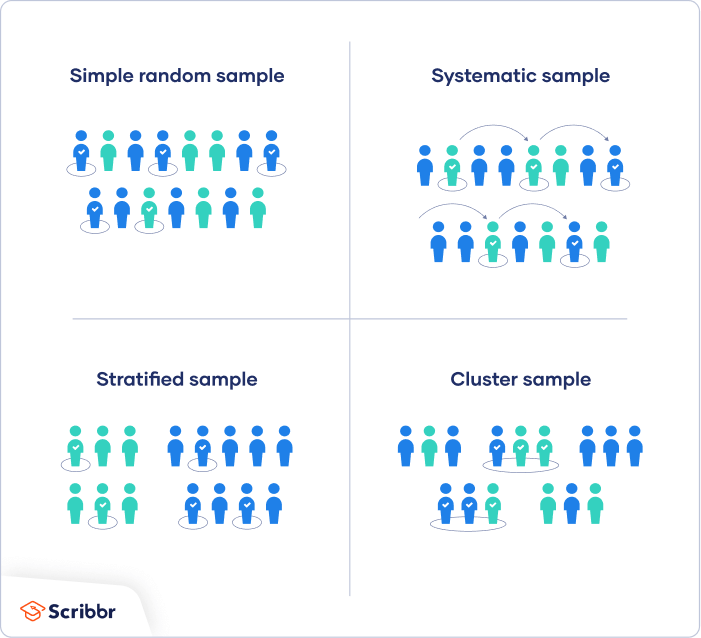
There are many ways of collecting an accurate sample.
Types of Sampling Styles
Simple Random
Simple random is when respondents are randomly selected from the desired population where everyone within the population has the same chance of being selected.
This is the least complicated method of selecting a sample as there are little to no requirements and gives the research method good viability as the sample is completely random.
Systematic
Systematic Sample selecting method is when respondents are selected from the larger population size randomly selected starting point but from a fixed periodic interval. Called the sampling interval it is created by dividing the larger population size by the wanted sample size despite this is considered random despite the selection of population being done in advance due to the random starting point.
Stratified
Stratified is used to select a sample that takes people from different groups (ethnicity, social groups etc.) if the groups are uneven the people or whatever the groups consist of will be evenly distributed into the final sample as each group will give an amount proportional to the desired sample size.
Cluster
Cluster method separates the population into smaller groups (Clusters). Randomly selected from these clusters to create a sample, used to study large populations especially ones with unusual geographically population locations that vary drastically. Most often they use existing units like cities, universities.
Questionnaire Design:
When designing a questionnaire you must consider the following:
Will it create the data you wanted?
You must use questions that apply to your intended purpose of the questionnaire rather than questions that are too vague or do not relate to the topic you want.
Is it clear?
Can it be easily understood and collected as it has good validity, the questions must be short and not convoluted in order to be easily understood by respondents and data collectors.
Is it functional?
Using Pilot Study when creating your questionnaire you must make sure that this data can be presented in this way while remaining under budget and be easily distributed.
My Example Questionaire
My target audience for this questionnaire is 16 to 18-year-olds so my sample size consists of people within this age demographic in my class. Due to my survey trying to determine the number of people in this demographic who were thinking about going into university after they completing A-Level's and if they weren't what else were they considering and why. So I created a simple questionnaire and handed it out to my classmates (which at the time we're in our 2nd year in A-level).
Are You Considering Going to University After A-Levels? |
(Please Circle Your Answer Below) Yes or No
|
(Please Explain Your Answer in the Blank Space Below) |
If not, what other options are you considering going into after A levels? (Please Circle Your Answer Below) (Please Write Below Your Option If You Circled Other) |
Out of my sample of 15 classmates, the majority said they would be going into university with 10 people saying they would be enrolling in university while 5 people said they were not and selected other options as their choice. The data I gathered here allowed me to determine the percentage of my class were going into university and gave me a list of other options of enrolment post-A-level and proved the commission I was given was inaccurate according to these results.
Types of Questionnaires Distribution Methods:
Once the questionnaire has been created you must then distributed it, there are many ways to distribute a questionnaire that can be beneficial to some demographics of people depending on age, social standing etc.
Computer Questionnaire
Respondents are given a questionnaire by being messaged or received from a platform on a computer. Usually, by email, this method is great due to its cost-effectiveness and its ease of distribution and is quick and easy. However, the downside is that this method is often ignored and marked as spam in emails. This is most useful when targeting younger age demographics of people who grew up with technology, however, older demographics age 70+ have limited knowledge of technology and will be unable to answer the questionnaire even if they received it.
Example:
Telephone Questionnaire
Telephone questionnaires are when data collectors have their respondents called by a hired caller who has them answer the questionnaire vocally over the phone, the main pros of this method is that it can be completed quickly however it is expensive and for the most part people do not answer their phone to unknown callers with caller id being the default of all phone in all current models.
People are often uncomfortable with answering and talking on the phone to strangers and overall this technique is bad in most demographics of people.
Example:
In-House Survey
In-house, this type of questionnaire is when a researcher goes to the homes/workplaces of respondents in person and asks them to take part in a questionnaire, this method gives the questionnaire more focus from the respondents as they are physically there but its time consuming and expensive as you need a lot of people to go door to door asking them to answer questions and due to this it can take a lot of time for this reason. But many people don't wish to do questionnaires while in the private home or while working leading to negative reactions from questionnaire taker possible skewing results to be more negatively. This is good for getting older demographics to answer the question's (70+) that would not normally be able to access online styles, like a computer questionnaire.
Mail Questionnaire
This distribution of mail questionnaires is when they are delivered by post to respondents (often with a pre-paid envelope) this is great for contacting people who don't have an online presence like the 80+ demographic or people in poorer countries who have little to no internet access much like the in-house method and provides a more accurate response as they answer the questions at there own pace. This can, unfortunately, be expensive, slow and much like people marking email as spam often people ignore mail they are not expecting.
Example:
Different Questionnaire Structures:
Open Question's
questionpro.com
Open Questions within a questionnaire are questions which give the respondents space to elaborate and explain there answer. This allows for more detailed responses giving better detail allowing for more valuable data from each respondent. But this data can be hard to break down in post when finalising data. Making it both less reliable and viable as it cannot be used or gathered for the intended data analyse of a study.
Example:
Multiple Choice/Closed Questions
Closed Questions/Multiple Choice have straight answers you pick one of the listed options. Allowing for no explanation, compacting the questionnaire if there are to my options it can be confusing and discourages them to answer when their option is not listed. It allows the data/answers to be easily collected and provide reliability due to their overall simplicity.
Dichotomous Questions
Much like many Closed Question a Dichotomous question only has two options yes and no. The simplest/easiest way to structure the question in your questionnaire and due to the simplicity of this, it makes it easy to measure and compact into a study as it provides both a quicker way for responders to answer a questionnaire (due to there only being two options).
Example:
surveymonkey.com
Scaling Questions
Scaling Question/Ranking Questions is when you can answer a question on a scale/range of values (1-10, etc.). This style of questioning mixes the closed and the open question styles as it is contained to a number of answers without any room for explanation however it allows a respondent to pick the neutral stance on a topic rather than between two extreme opinions.
This is useful as it provides a straightforward answer that is viable and easily relatable to be added as accurate data for a study, however, depending on the scale range could be confusing to answer and may become difficult to analyse as data is separated into the scale values, as well as the respondent becoming overwhelmed with the amount of choice.
Example:
Evaluation of Questionnaires
Questionnaires as a research method allow for flexibility in how you want to gather data.
Because questionnaires are simple and basic in structure because they are a simple list of questions. You can use a multitude of distribution techniques to reach any target audience/key demographic by using technology with online computer questionnaires, which allow you to target people at home relatively cheaply. And with social media apps like Instagram, Facebook and Snapchat, etc. You can use them to reach younger audiences like teenagers (18 to 14) by having these questionnaires shared through accounts in these apps. However, these online methods of advertising/distributing questionnaires can be easily ignored and blocked from online assets like Adblocker's on these social media apps and marking spam in emails.
Also as A.N Oppenheim says in their book "Questionaire Design, Interviewing and Attitude Measurement (new edition) 1992" "Too often, surveys are carried out on the basis of insufficient design and planning or on the basis of no design at all" they state that questionnaires often have "misguided" data due to these facts and this usually goes unnoticed until after the distribution phase.
(Questionaire Design, Interviewing and Attitude Measurement (new edition) A.N Oppenheim1992)
But their flexibility as a research method wanted/needed you can target older demographics like people age 70 and over. You can use other methods as their lack of skill and knowledge to use the internet makes it difficult for them to fill online methods like computer questionnaires on email and social media, which will not reach them or will go unnoticed by them. But with the easy layout of the questionnaire, allows you to distribute it to them via physical media as well.
This can be done through the post with mail questionnaires which help reach these older demographics as well as populations that are unable to use the internet. Or can be served to these respondents in your sample in person with In-House techniques by hiring a researcher to physically knock on people doors for answers to the questionnaire. These physical methods are much more expensive however as you must hire additional manpower for In-House visits to sample neighbourhoods and both are slower process as it takes time to collect physical data, along with the fact that the mail may be ignored and the responders being annoyed by in-person visits despite the more focused responses they will give due to a researcher being present during the process.
Questionnaires aren't just a good research method due to their variation in distribution but also because of their varied structure.
A questionnaire can be constructed to collect any type of data from an individual in a sample. As Bill Gillham in his book "Developing a Questionaire (2nd Edition)" 2000, he says that questionnaires "Provide a 'quick fix' to research methodology" this is because it can use different techniques in its structure easily and effectively depending on its purpose like open questions to allow for detailed responses that are new and original to the respondent, giving specific and complex data that can be evaluated.
Or a questionnaire that can use concise closed questions and dichotomous questions which can be easily and quickly answered giving viable and representative data that can be easily applied to the study.
However, both styles of the structure have their problems multiple-choice/closed questions in a questionnaire give readable and reliable data but can't truly articulate the answer of a respondent. And despite open questions allowing them to give these detailed responses the responses are unintelligible data that is unreliable and lacks viability by being too complex to accurately measure.
Comparing questionnaires to other research instruments like interviews which have respondents come in for a one to one with an interviewer to answer questions, which can also be varied in their structure using closed and open questions but having further engagement from the physical proximity.
Or Observational Trials which watch respondents in natural life over long periods of time giving them concise and furrow data but unlike a questionnaire, this data despite its arguable better collection from their sample takes too long and would be too expensive to perform on large population samples/groups.
The questionnaire is obviously the most reliable and easiest to use for a relatively cheap cost to gather information on large populations. While also being quick to collect and distribute.
Overall questionnaires as a research instrument allow data collectors to create a structure and distribution that can analyse data from a large population of any demographic with its simplicity allowing it to focus on anyone or any application whether it be collecting for a company's data to see the creation of a perfect product or a medical study that wants to prove psychological studies like Freudian theories legitimacy.
In conclusion, questionnaires are the best way to harvest data and reliably analyse its validity for a study at a low affordable cost.
But as Jerome Kirk, Marc L. Miller stated in their book
"Reliability and Validity in Qualitative Research" 1985
"The problem with validity, no experiment can be perfectly controlled and no measuring instrument can be perfectly calibrated. All measurement, therefore, is to some degree suspect".
Meaning that no research measurement is fully accurate due to the solution we use to make it easier to harvest.
Reference List:
https://research-methodology.net/research-methods/survey-method/questionnaires-2/
"Questionaire Design: How to plan, structure and write survey material for effective market research (Second Edition)" Written by Ian Brace 8 Jan 2008, Available to buy (
Online) at:
https://www.amazon.co.uk/Questionnaire-Design-Structure-Material-Effective/dp/0749450282
"Questionaire Design, Interviewing and Attitude Measurement (new edition) Written by A.N Oppenheim 1992, Available to buy (
Online) at:
https://www.amazon.co.uk/Questionnaire-Design-Interviewing-Attitude-Measurement/dp/0826451764
https://research-methodology.net/research-methods/survey-method/questionnaires-2/
https://help.highbond.com/helpdocs/highbond/en-us/Content/results/questionnaires/distribute_questionnaires.html#:~:text=Once%20you%20create%20a%20questionnaire,table%20as%20an%20anonymous%20link.